Chestnuts Not for Roasting: A Festive Human Factors Lesson From My Microwaave
Basics
Dec 11, 2025
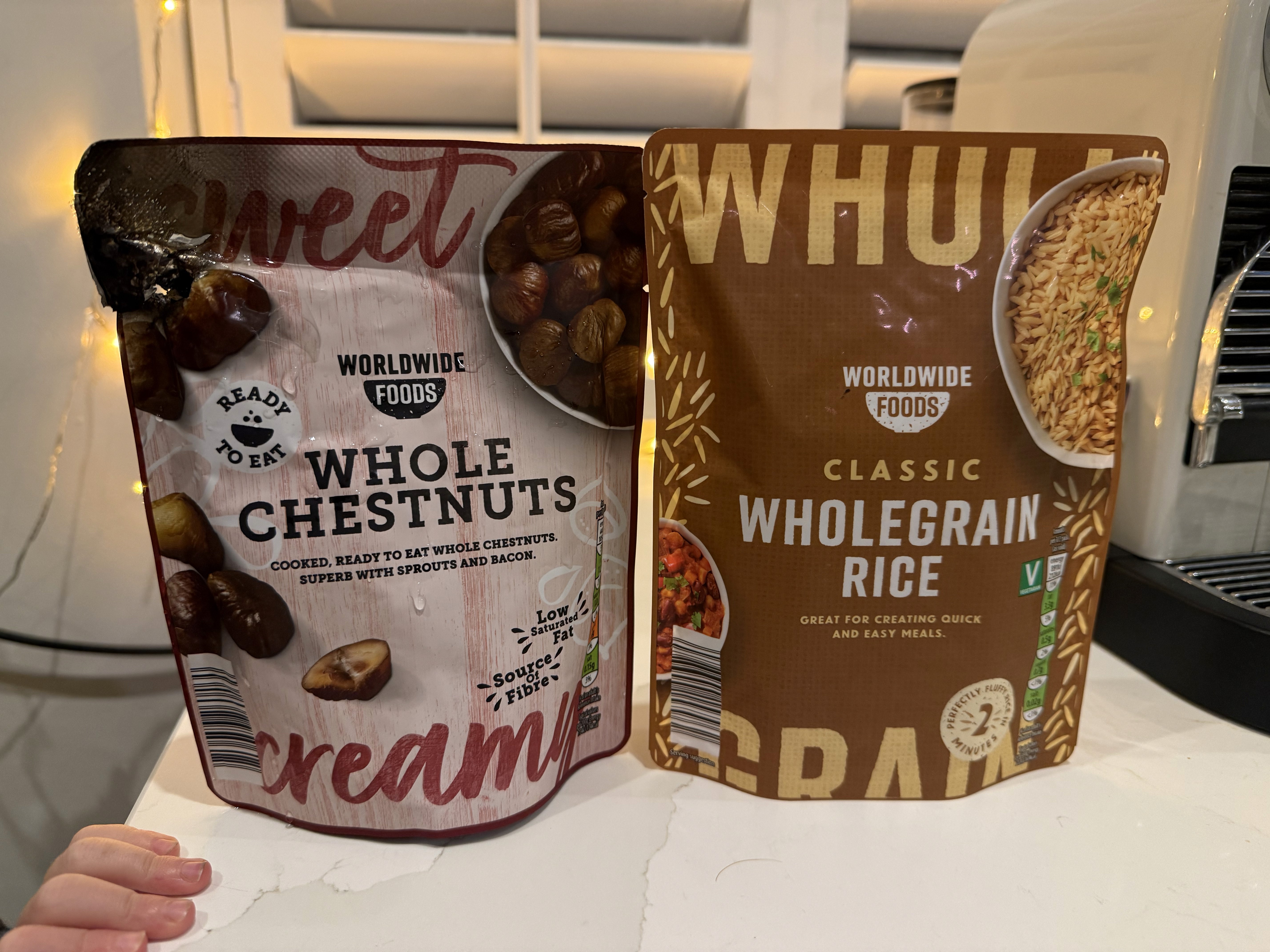
An accident at home.
A ready-to-eat chestnut pouch. It looks like a microwave-safe rice pouch, feels like a microwave-safe rice pouch, the smell’s a bit different, but that’s because I fancy having some chestnuts, not rice. Either way, it’s got to be microwavable!
Dinner is in full swing, our two-year-old on my hip, and I’m thinking sixty seconds in and leave it to stand for thirty more should do it.
Assumptions used? Check.
Plan made? Check.
Here we go: a familiar beep and a hum, followed by an unfamiliar popping sound and a deeply concerning flame bursting from the side of the bag.
I’d become rapidly privy to the Top Event from a Risk Bowtie I was blissfully unaware of having been partaking in. Luckily, still being stood near to the microwave, I was able to open it up to stop it, recovering from what could’ve been a job for Humberside Fire and Rescue - followed swiftly by informing my wife that the smell of burnt plastic was ‘nothing to worry about!’ while poking the mildly molten packet to figure out why my attempt at simulating the hot roasted flavours I love about chestnuts had been a bit too successful.
Aluminium package linings and microwaves do not mix.
Though no warning label was present that could override my preconceptions about the packaging. Same form factor. Similar graphics. Very different rule.
This was my latest personal encounter with the dreaded effect known as ‘negative transfer.’
Negative transfer occurs when users apply a learned rule from one context to another that looks or feels similar but has a crucial difference. During a busy family-dinner-time rush, with a toddler to pay attention to, we rely on recognition, not deep analysis. Our brains take shortcuts; when the physical format and visual cues mimic microwave-safe products, the mind readily imports the microwavable rule – even if the rule ‘metal in the microwave is a bad idea’ breaks it. In Human Factors terms, the design failed to disconfirm the unsafe action at the point of decision.
Why this matters beyond the kitchen.
We can see the same pattern across medical devices and combination products: lookalike components, subtle label differences, and ambiguous instructions. All can lead clinicians or patients to apply the wrong learned rule:
Similar syringes with different needle hub compatibility
Catheter accessories with lookalike connectors that shouldn’t be swapped
Consumables in familiar formats that change the critical step (e.g., priming, sterilisation, or storage)
When everyday workload, stress, or interruptions are present, designers must carry the burden of guidance. That is the essence of Human Factors—and it’s codified in standards such as IEC 62366-1 and reflected in regulatory guidance on labelling, IFUs and risk control.
Design takeaways for packaging, IFUs, and user interfaces
1) Different form for a different function
If a pack cannot be microwaved, avoid formats that strongly imply microwave use. Distinctive form factors, such as a different opening (e.g., zip lock rather than tear) or a different shape (e.g., shorter or wider packaging), break the mental link and reduce negative transfer.
2) Hard to miss signal words & icons
Put “DO NOT MICROWAVE” on the front of the pack with a high contrast typography and a standard metal icon. The rationale (e.g., ‘package contains metal/aluminium’) can be on the back, but the primary dissuader must be visible at a glance.
3) Errorproof the busy moment
Design for salience under load. In kitchens and clinics alike, people make these decisions in 1–2 seconds. Use bold icons, colour blocks, and a pattern interrupt (e.g., a black and yellow band) that disrupts reading patterns
4) Cue hierarchy and proximity
Position the critical cue exactly where the action starts (front panel, near the tear notch, at the microwave icon area). Avoid burying prohibitions in small print or on the rear panel.
5) Consistency across product families
If some pouches are microwave-safe and others are not, create two families with clearly distinct visual systems (e.g., backgrounds, iconography, and structural cues) so the “microwave rule” doesn’t leak across the range.
6) Validate with intended users
Run formative studies that recreate real context: time pressure, noise, routine multitasking. Observe whether people notice the cue and what mental model they use. Iterate until unaided behaviour consistently aligns with safety.
A helpful checklist: spotting negative transfer risks
Use this five-minute scan before you ship packaging, IFUs, or UI changes:
Does the new format closely resemble a standard, familiar format with different rules?
Are critical prohibitions salient? Such as on the front in high contrast, with an icon and a reason.
Is there a distinctive pattern interrupt (e.g., through changes in shape, colour, material) that breaks a user’s autopilot?
Would a user under distraction or time pressure still make the safe choice?
Have we tested with the intended users under a realistic workload—and adjusted based on observed errors?